
One Health Meets
One Platform
The One Health approach recognizes that human, animal, and environmental health are deeply interconnected. NexSuite Cloud was built for exactly this kind of cross-sector, multi-agency collaboration — making it the natural technology backbone for any One Health initiative on the African continent.
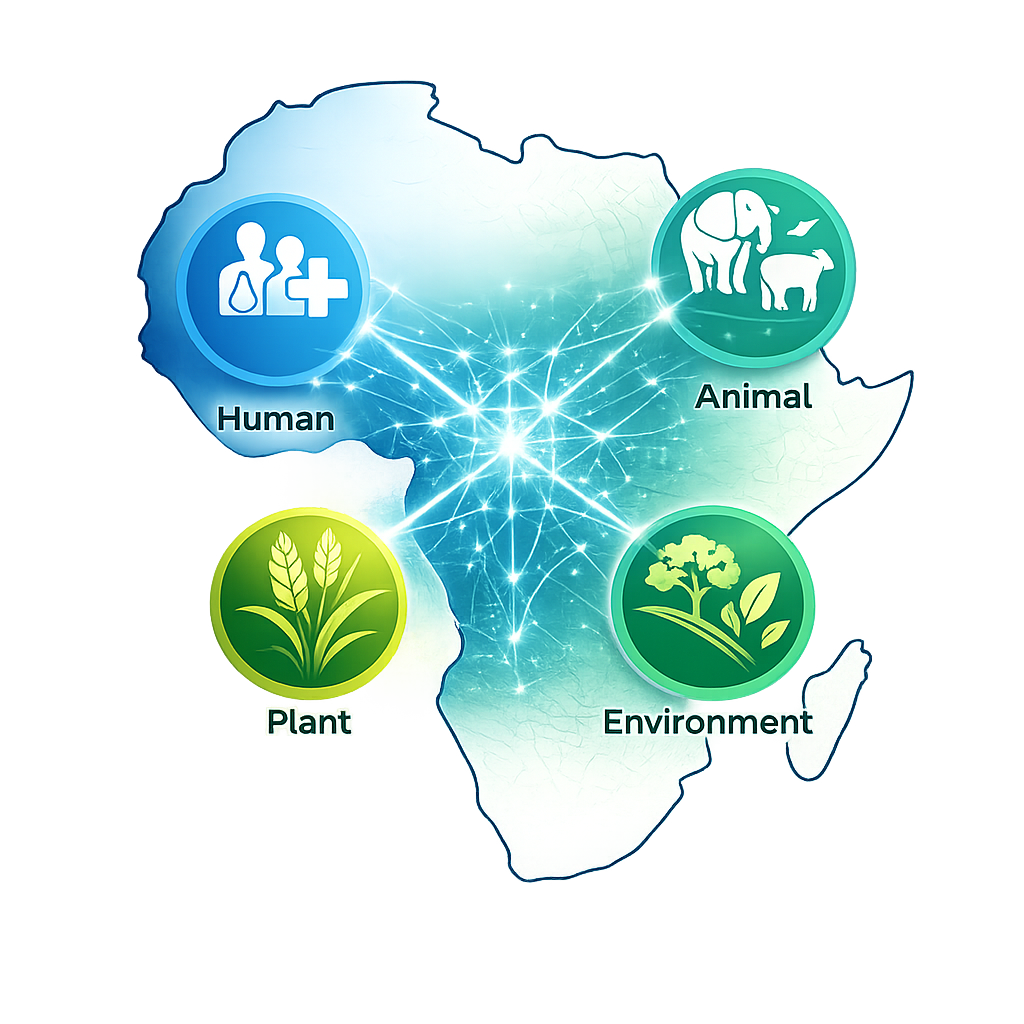
What Is One Health?
A globally recognized framework endorsed by the WHO, FAO, WOAH, and UNEP for tackling health challenges that span humans, animals, and the environment.
One Health is an integrated approach that aims to sustainably balance and optimize the health of people, animals, and ecosystems. Defined by the One Health High-Level Expert Panel (OHHLEP) in 2021, it recognizes that the health of humans, domestic and wild animals, plants, and the wider environment are closely linked and interdependent.
For Africa, where zoonotic diseases like Ebola, avian influenza, and Rift Valley fever regularly cross species barriers — and where food safety, antimicrobial resistance, and environmental degradation are urgent priorities — the One Health approach isn't optional. It's essential.
The OHHLEP framework identifies four pillars that take One Health from theory to practice — and each one maps directly to capabilities already built into NexSuite Cloud.
Communication
When Threats Move Faster Than Information
A zoonotic outbreak in a rural region shouldn't take days to reach the national public health authority — and weeks to reach neighboring countries. But that's exactly what happens when food safety, animal health, and environmental agencies communicate through fragmented channels, email chains, and phone trees. In a One Health context, an outbreak detected at a livestock market has implications for human health, food supply chains, and environmental contamination simultaneously. Information must reach all sectors — instantly.
Simultaneously broadcast critical alerts across email, SMS, and voice to reach every stakeholder in your One Health network — from veterinary field officers to public health directors to environmental regulators — in minutes, not days.
Secure, auditable messaging channels organized by workgroup ensure that sensitive outbreak information stays protected while flowing freely between the human health, animal health, and environmental teams that need it.
Speed and reach across every sector
75% faster response times — Multi-channel alerts reach field officers, lab directors, and ministry officials simultaneously, eliminating the "telephone game" that delays outbreak response across sectors.
Cross-sector notification routing — A single alert about contaminated livestock feed automatically notifies veterinary, public health, food safety, and environmental agencies — each receiving role-appropriate information through secure channels.
Complete communication audit trails — Every alert, message, and notification is logged with timestamps and read-receipts, creating the accountability record that international health frameworks require.
Are Outbreaks Outpacing Your Communications?
See how Vinna Alerts can connect every sector in your One Health network within minutes.
Request a Communication Demo →Collaboration
Silos Between the Sectors That Need Each Other Most
Antimicrobial resistance doesn't respect the boundary between your veterinary service and your public health ministry. Food contamination events involve agriculture inspectors, lab scientists, environmental officers, and trade regulators. Yet these groups typically work in completely separate systems — different databases, different documents, different workflows — making true multi-disciplinary collaboration nearly impossible. One Health demands that these sectors work as one team, not four separate departments exchanging PDFs.
Enterprise social collaboration workspaces where human health, animal health, food safety, and environmental teams share intelligence, discuss cases, and coordinate responses in a single unified environment — with granular access controls ensuring each participant sees only what they're authorized to.
Share investigation reports, lab results, surveillance data, and policy documents across agencies and across borders with AES encryption, version control, and online viewing — without ever attaching sensitive files to unsecured email.
One workspace for every sector
One platform replaces 15+ separate tools — Instead of cobbling together email, file sharing, project management, and messaging from different vendors, every One Health stakeholder works in a single integrated ecosystem with shared data and a single login.
Workgroup-based multi-tenancy with full data sovereignty — Each nation and agency controls exactly who sees what, enabling the trust needed for veterinary services to share AMR data with public health, or for one country to share outbreak intelligence with its neighbors.
Real-time joint investigations — When a zoonotic event requires simultaneous human epidemiology, animal tracing, and environmental sampling, all teams work from the same case file with shared timelines, documents, and status updates.
Are Your One Health Partners Working in Silos?
See how a unified platform can bring veterinary, public health, and environmental teams onto the same page — literally.
Request a Collaboration Demo →Coordination
Aligned Intentions, Unaligned Actions
African nations and the African Union have set ambitious food safety and health objectives through the AU 2022–2036 strategic framework. But translating continental strategy into coordinated national action requires more than policy documents — it requires shared workflows, unified data, and synchronized operational rhythms across agencies and borders. Without coordination infrastructure, even well-funded programs produce duplicated efforts, contradictory responses, and reporting gaps that undermine the entire One Health agenda.
Real-time dashboards that aggregate data from surveillance, laboratory, field operations, and compliance modules into a single operational picture. When every sector sees the same KPIs and trend data, coordination stops being a meeting agenda item and becomes the default operating mode.
Configurable approval routing, retention schedules, and compliance tracking that align national activities with AU strategic objectives. NARA-grade records management ensures every inspection, lab result, and policy action is documented, findable, and audit-ready.
From continental strategy to daily operations
Continental-level visibility — Aggregated analytics give AU leadership and regional bodies a real-time view of One Health activities across member states, turning the 2022–2036 strategic objectives from aspirational targets into measurable, monitored outcomes.
Standardized workflows eliminate duplication — When Botswana and its neighbors use the same platform for outbreak investigation, sample tracking, and compliance reporting, cross-border coordination becomes automatic rather than a special project requiring weeks of planning.
50% reduction in operational costs — A proven metric from US deployment, driven by eliminating redundant systems, reducing manual reporting overhead, and replacing costly custom integrations with built-in interoperability across all 15+ platform modules.
Struggling to Align National Action with Continental Strategy?
See how unified analytics and standardized workflows can make AU objectives operational, not aspirational.
Request a Coordination Demo →Capacity Building
The Workforce Exists — The Tools and Training Don't
Africa has committed, talented professionals working in public health, veterinary medicine, food safety, and environmental science. But One Health capacity isn't just about having people — it's about giving them the knowledge, tools, and institutional infrastructure to work effectively across disciplines. Training programs are often one-off workshops. Standard Operating Procedures live in filing cabinets. Laboratory competency records are managed on spreadsheets. Building lasting One Health capacity requires a permanent, accessible infrastructure for learning, assessment, and institutional knowledge that survives staff turnover.
A self-service knowledge hub and enterprise video platform that centralizes SOPs, training materials, best-practice guides, and instructional videos. Field officers, lab technicians, and policy staff access the latest protocols from any device — ensuring consistent One Health practices across every agency and every nation on the platform.
Advanced quiz, survey, and competency assessment tools linked directly to training records and certification tracking. Verify that every inspector, lab analyst, and coordinator has completed required One Health training — and generate the compliance documentation to prove it during audits.
Permanent institutional capability
Institutional knowledge that survives turnover — When a trained inspector moves on, their expertise doesn't leave with them. SOPs, investigation templates, case histories, and training materials remain in the platform's knowledge base, immediately accessible to their replacement.
70% reduction in support tickets — Self-service knowledge bases mean field staff can find answers to procedural questions instantly, reducing dependence on senior staff and enabling more autonomous, confident One Health operations at every level.
Continuous competency verification — Automated assessment scheduling, competency tracking, and certification management ensure One Health training isn't a one-time event but an ongoing institutional practice with full audit trails for accreditation bodies.
Ready to Build Lasting One Health Capacity?
See how integrated training, knowledge management, and competency tracking create permanent institutional capability.
Request a Capacity Building Demo →One Health Demands
One Platform
NexSuite Cloud wasn't built in theory — it was built for the exact kind of cross-sector, multi-agency, multi-nation collaboration that One Health requires. It's already proven at continental scale in the United States. Now it's ready for Africa.